


여러분은 봄이 왔음을 언제 처음 느끼시나요?
저는 ☕무심코 집을 나서다 달라진 공기의 온도를 마주할 때, ☕마음이 들뜨기 시작합니다. 그러다 가지마다 부푼 꽃망울들이 톡 터지는 ☕찰나를 마주할 때, ☕비로소 ☕완연한 봄임을 실감하곤 하죠. 그 ☕설레는 마음을 모아 3월부터 5월까지, 한국의 봄을 아름답게 ☕장식하는 아홉 가지 꽃 이야기를 들려드릴게요.
무심코 unconsciously ⠀ ⠀마음이 들뜨다 to feel hyped ⠀ ⠀찰나 the moment of ⠀ ⠀비로소 finally ⠀ ⠀완연하다 to be full swing ⠀ ⠀설레다 to feel a flutter of heart ⠀ ⠀장식하다 to grace; to decorate
When do you first feel the arrival of spring?
For me, it vaguely starts when I step out the door and notice the subtle change in the temperature of the air, and my heart skips a beat. However, it is only when I witness the swollen buds on the branches finally 'pop' open that I truly feel spring is in full swing. To share this joyful anticipation, I’ve gathered the stories of nine flowers that beautifully grace the Korean spring from March to May.
1막: 3월, 가장 먼저 도착한 봄의 인삿말
Act 1: March Delivers the Very First Greetings of Sprin
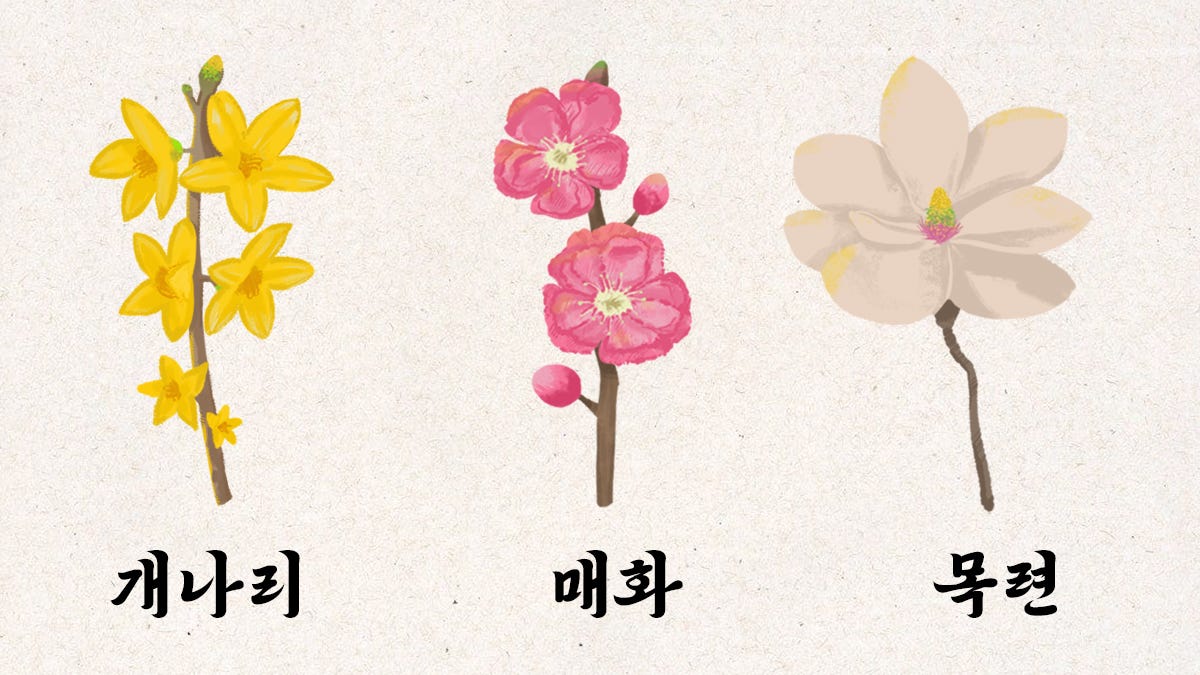
🩷매화 (2월 말 ~ 3월 초순)
Plum Blossoms (Late February – Early March)
매화는 다섯 장의 둥근 꽃잎이 나뭇가지에 ☕바짝 붙어 피어나는 꽃입니다. 늦겨울의 찬 바람을 ☕뚫고 가장 먼저 피어나는 꽃이라, ☕예로부터 ☕지조와 절개의 상징으로 사랑받아 왔습니다. 색은 두 가지로, 흰색은 백매화, 붉은 색은 홍매화라 부릅니다. 두 매화의 ☕정취를 제대로 ☕만끽하려면, 백매화가 하얀 ☕꽃구름처럼 피어나는 광양 매화마을과 천연기념물로 지정된 멋진 흑매가 있는 구례 화엄사에 들러 보세요. 봄의 전령, 매화의 매력에 온전히 집중할 수 있을 거예요.
N에 바짝 붙다 to attach oneself closely to N ⠀ ⠀N을 뚫다 to pierce through N ⠀ ⠀예로부터 for ages ⠀ ⠀ 지조와 절개 unbending integrity and loyalty ⠀ ⠀정취 the mood and ambience ⠀ ⠀만끽하다 to savor
Plum blossoms feature five round petals that bloom close to the branch. As the earliest bloomers that pierce through the cold winds of late winter, they have long been cherished as a symbol of unbending integrity and loyalty. The blossoms primarily appear in two colors: the white baek-maehwa and the red hong-maehwa. For a proper viewing, visit Gwangyang Maehwa Village, where white blossoms blanket the landscape like rolling clouds, and Hwaeomsa Temple in Gurye. The temple is home to the magnificent heuk-mae (a black plum blossom)—a rare gem officially designated as a Natural Monument for its particularly striking red hue. These spots will allow you to immerse yourself in the beauty of the plum blossom, the true messenger of spring.
💛개나리 (3월 중순 ~ 3월 말)
Forsythia (Mid to Late March)
개나리는 잎보다도 먼저 고개를 내미는 작은 ☕샛노란 꽃입니다. 꽃송이 하나하나만 보면 그저 귀여울 뿐이지만, 수십 송이가 가지마다 ☕오밀조밀 촘촘히 맺혀 노란 폭포수를 이룰 때쯤에는 ☕여느 꽃 못지 않은 ☕장관을 이룹니다. ‘희망’이라는 꽃말에 ☕충실하려는 듯, ☕척박한 땅이나 공해 속에서도 ☕꿋꿋하게 잘 피어나, 잿빛 도심 깊숙한 곳까지 따뜻한 봄 소식을 전하는 ☕기특한 꽃입니다.
샛노랗다 to be vivid yellow ⠀ ⠀오밀조밀 depicts a dense cluster of things ⠀ ⠀여느 N 못지 않다 to be as good as any other N ⠀ ⠀장관을 이루다 to create a spectacle ⠀ ⠀N에 충실하다 to live up to N ⠀ ⠀척박하다 to be barren ⠀ ⠀꿋꿋하게 resiliently ⠀⠀기특하다 to be praiseworthy
The forsythia is a tiny, vivid yellow flower that pokes its head out even before the leaves appear. While each individual blossom is charming on its own, when dozens of them cluster densely along the branches to form a "yellow waterfall," they create a spectacle as grand as any other flower. Living up to its floral meaning of "hope," the forsythia steadfastly blooms even in barren soil or polluted environments, admirably delivering the warm promise of spring deep into the gray heart of the city.
🤍목련 (3월 중순 ~ 3월 말)
Magnolia (Mid – Late March)
목련은 ☕앙상한 가지 끝에 등불처럼 피어난다고 해서 ‘나무에 핀 연꽃’이라고도 불립니다. 북쪽을 바라보는 도심의 백목련과 달리, 제주 한라산의 ☕토종 목련은 꽃잎을 활짝 펼치는 독특한 생김새를 지녔죠. 1억 4천만 년 전부터 생명력을 이어온 이 원시식물은, ☕비록 일주일 ☕남짓 짧게 머물다 떠나가지만 그 ☕우아하고 고귀한 자태로 우리에게 깊은 ☕여운을 남깁니다.
앙상하다 to be bare ⠀ ⠀토종 a native species ⠀ ⠀비록 …지만 Although; Even though ⠀ ⠀(기간) 남짓 A little over (a duration) ⠀ ⠀우아하고 고귀한 자태 an elegant and noble presence ⠀ ⠀여운 a lingering impression
Magnolias are often dubbed “lotus flowers blooming on a tree” due to their resemblance to lotus lanterns when in full bloom. The ones we most commonly encounter in the city are white magnolias, a species whose flowers open up like cups facing north. By contrast, the magnolias native to Jeju's Hallasan Mountain spread their petals as wide as they can. This primitive flower, whose origins date back almost 140 million years, stays with us for only about a week each year. Yet, the impression of elegance and nobility it leaves behind lingers far longer.
2막: 4월, 온 세상을 물들인 봄의 미소
Act 2: April Colors the World with the Smiles of Sprin
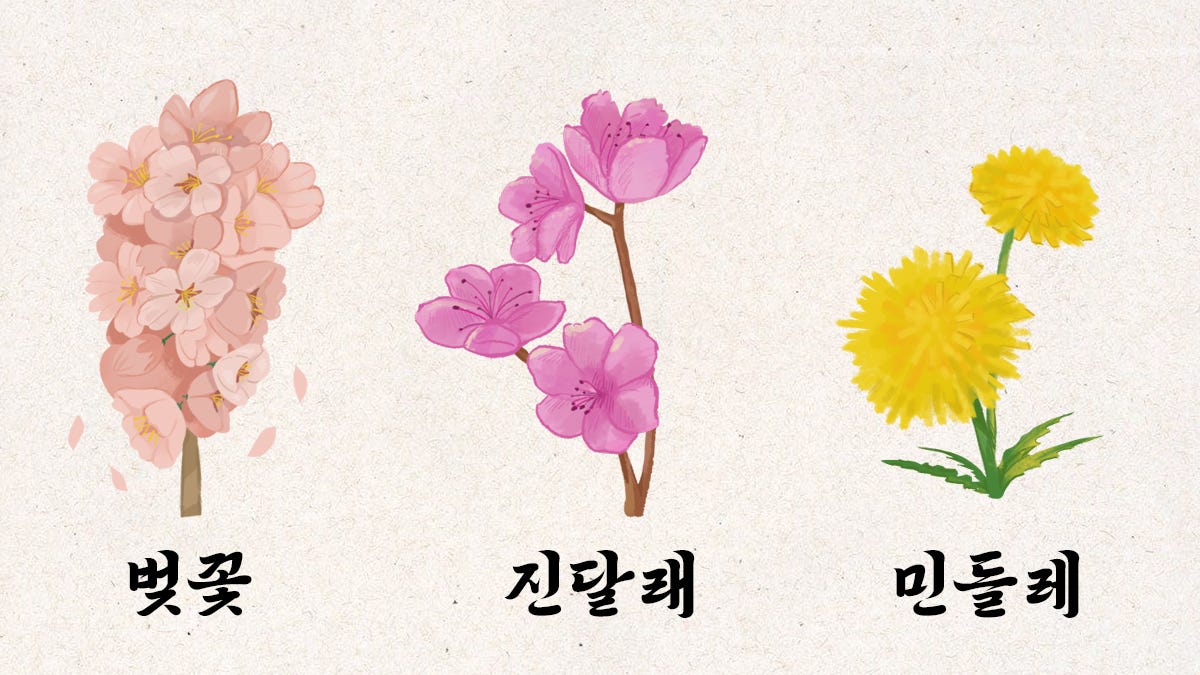
🌸벚꽃 (남부 3월 말 ~ 중부 4월 초)
Cherry Blossom (Late March in the South – Early April in the Central Region)
하트 모양 꽃잎이 팝콘처럼 터져 나오는 벚꽃은 도심을 연분홍빛 구름으로 물들입니다. ☕흩날리는 ‘☕꽃비’ 아래서 남기는 사진 한 장은 그해 봄을 ☕만끽했다는 ☕근사한 증명서가 되죠. 찰나의 화려함 뒤에 남는 ☕애틋함, 그 로맨틱한 ☕미학은 매년 우리에게 새로운 설렘을 선물합니다.
흩날리다 to flutter in the air ⠀ ⠀꽃비 a flower rain; falling petals ⠀ ⠀만끽하다 to savor ⠀ ⠀근사한 wonderful ⠀ ⠀애틋함 wistful affection ⠀⠀ ⠀미학 aesthetic
With heart-shaped petals bursting like popcorn, cherry blossoms color the city in a soft pink cloud. Koreans consider a perfect photo taken under the fluttering “cherry blossom rain” as wonderful proof that you have fully enjoyed the spring that year. Though their splendor may last for only a brief moment, the wave of warmth and emotion they stir within us feels brand new every year.
🩷진달래 (3월 말 ~ 4월 초)
Korean Azalea (Late March – Early April)
☕은은한 벚꽃과 달리 진한 분홍빛 ☕자태를 ☕뽐내는 진달래는 길게 뻗은 열 개의 수술을 ☕삿갓 모양의 통꽃이 ☕탐스럽게 감싼 모양을 하고 있습니다. ☕웬만한 추위에도 ☕아랑곳하지 않아서 겨울이 머무는 높은 ☕산등성이까지 찾아가 봄의 시작을 알립니다. 산, 들, 담장 아래, 길가, 어디에서든 ☕꿋꿋이 피는 데다, ☕독성도 없어서, 예로부터 한국인들은 진달래를 화전으로 구워 먹거나 술로도 ☕담가 먹곤 했답니다.
은은하다 to be subtle ⠀ ⠀자태 form and attitude ⠀ ⠀N을 뽐내다 to boast of N ⠀ ⠀삿갓 a satgat (Korean conical bamboo hat) ⠀ ⠀탐스럽다 to be plump and full ⠀ ⠀웬만한 N quite an impressive N ⠀ ⠀N에도 아랑곳하지 않다 to be undeterred by N ⠀ ⠀산등성이 a mountain ridge ⠀ ⠀꿋꿋이 resiliently ⠀⠀ ⠀독성 toxicity ⠀ ⠀담그다 to brew
Unlike the pastel pink of cherry blossoms, the Korean azalea boasts a deep pink hue, with its bell-shaped petals gracefully encircling ten long, elegant stamens. Undeterred by the late frost, it climbs high mountain ridges to push away the last of winter and announce the arrival of spring. Because it blooms resiliently everywhere—from mountains and fields to stone walls and roadsides—and is entirely non-toxic, Koreans have traditionally enjoyed using its petals to pan-fry sweet hwajeon (flower cakes) or brew floral wine.
💛민들레 (4월 ~ 5월)
Dandelion (April - May)
민들레는 수십 개의 작은 꽃송이가 ☕촘촘히 모여 하나의 큰 꽃을 이루는 ☕흥미로운 구조를 지녔습니다. 흔히 보는 노란 ☕외래종과 달리 하얀 꽃받침이 꽃송이를 ☕포근하게 감싸는 한국 토종 민들레는, 봄철 짧게 피어 네잎클로버보다 찾기 힘들 만큼 ☕귀한 존재입니다. 꽃잎이 머문 자리마다 돋아난 ☕솜털 씨앗들은 때가 되면 바람을 타고 ☕홀홀히 날아가, 내년 봄 다시 만날 날을 ☕기약하며 긴 여행을 떠납니다.
촘촘히 densely ⠀ ⠀흥미롭다 to be fascinating ⠀ ⠀외래종 a non-native species ⠀ ⠀포근하다 to feel soft and cozy ⠀ ⠀귀하다 to be rare and precious ⠀ ⠀솜털 fine hair ⠀ ⠀홀홀히 (flying) in an airy manner ⠀ ⠀기약하다 to promise a comeback
The dandelion has a fascinating structure, where dozens of tiny blossoms gather closely together to form a single, large flower. Unlike the common yellow non-native species, the native Korean dandelion—with delicate white sepals softly embracing the bloom—appears only briefly in spring and is so rare that finding one is harder than spotting a four-leaf clover. Where the petals once rested, fluffy seeds soon form. When the time comes, they catch the breeze and drift away, embarking on a long journey with a promise to return next spring.
3막: 5월, 봄이 건네는 마지막 선물
Act 3: May Delivers the Final Gifts from Sprin
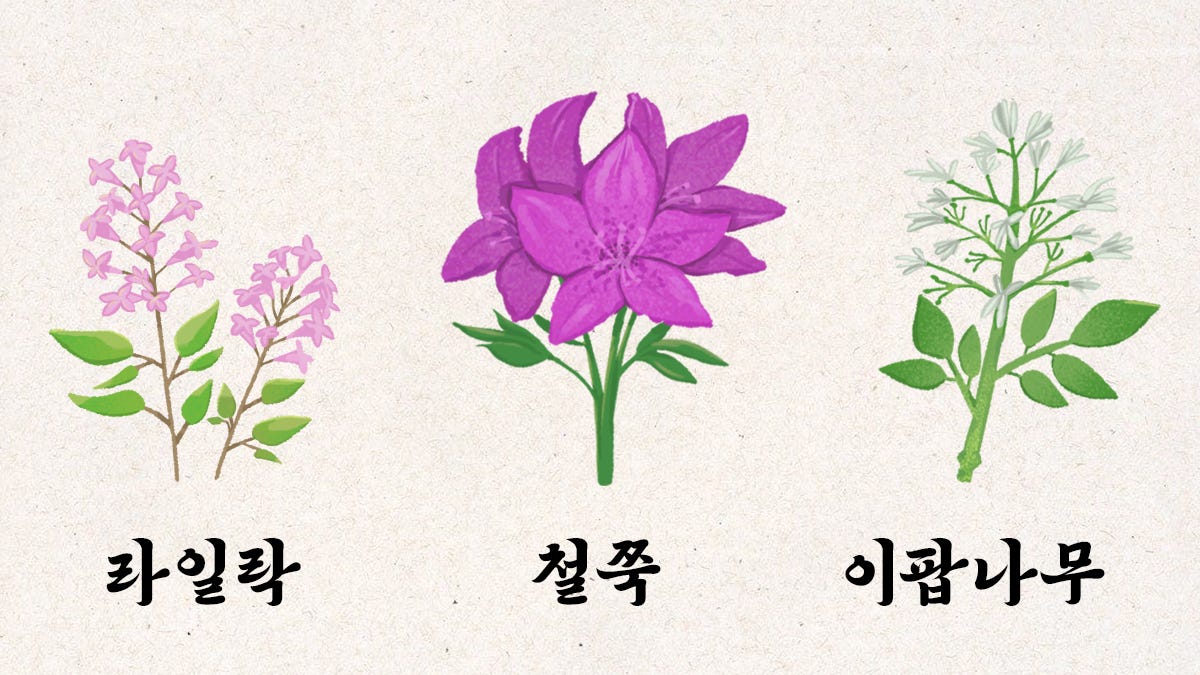
🩷철쭉 (4월 중순 ~ 5월)
Royal Azalea (Mid April - May)
진달래의 바통을 이어받아 늦봄까지 ☕산천을 물들이는 철쭉은 꽃잎 속 짙은 ☕자주색 ‘꿀샘’ 덕분에 더욱 ☕농밀한 분홍빛을 뽐냅니다. 다만, 진달래와 달리, 아름다움 이면에 독성을 ☕품고 있어서 절대 먹으면 안 됩니다. 구별법은 간단합니다. 진달래는 잎보다 먼저 피고 철쭉은 잎과 함께 피거든요. 그러니, 분홍빛 꽃만 가득 피어있으면 진달래고, ☕싱그러운 초록 잎사귀와 꽃이 ☕함께 어우러져 있다면 철쭉이랍니다.
산천 mountains and fields ⠀ ⠀자주색 crimson red ⠀ ⠀농밀하다 to be dense and rich ⠀ ⠀품고 있다 to be carrying ⠀ ⠀싱그럽다 to be vibrant and fresh ⠀ ⠀함께 어우러지다 to harmonize with
Following the Korean azalea, the royal azalea colors the landscape well into late spring with a richer pink hue, accented by crimson "honey spots." But beware: beneath its beauty lies a hidden toxicity, so it must never be eaten. Telling the two apart is simple: Korean azaleas bloom before their leaves appear, offering a pure display of pink petals, while royal azaleas bloom alongside their vibrant green foliage. This is because, Korean Azaleas bloom before the leaves appear, while Royal Azaleas bloom together with the leaves.
💜라일락 (4월 말 ~ 5월 중순)
Lilac (Late April - Mid May)
라일락은 하트 모양의 잎사귀 사이에 피어나는 원뿔 모양의 보라색 꽃입니다. 꽃다발처럼 꽃송이들이 ☕빽빽하게 뭉쳐 피어 ‘첫사랑’이라는 꽃말을 얻었어요. 한국의 토종 라일락은 ☕수수 이삭처럼 생겼다하여 ‘수수꽃다리’라고 불립니다. 한편, 누가 들어도 한국 ☕냄새가 물씬 나는 ‘미스김 라일락’은 ☕오히려 미국에서 태어났답니다. 미국 식물학자 엘윈 미더(Elwin M. Meader)가 1947년 한국에서 수수꽃다리의 형제 ☕격인 ‘털개회나무’ 종자를 미국으로 가져가 ☕개량했다고 해요. ‘미스김’이라는 이름은 ☕당시 한국인 비서의 성 씨를 따서 붙인 거라고 하네요.
빽빽하다 to be tightly clustered ⠀ ⠀수수 이삭 ears of sorghum ⠀ ⠀N 냄새가 물씬 나다 to evoke unmistakably of N ⠀ ⠀오히려 rather ⠀⠀ ⠀N 격이다 to be similar to N ⠀ ⠀개량하다 to cultivate ⠀ ⠀당시 back then
The lilac features cone-shaped clusters of purple flowers that bloom among heart-shaped leaves. Because its blossoms bunch tightly together like a bouquet, the flower has earned the meaning of "first love." The native Korean lilac is called susukkottari, named for its resemblance to the ears of sorghum (susu). Meanwhile, the Miss Kim lilac—which sounds unmistakably Korean—was actually developed in the United States. In 1947, American botanist Elwin M. Meader brought seeds of the hairy lilac, a close relative of the susukkottari, from Korea to the U.S. and cultivated them into a new variety. It is said that he named it "Miss Kim" after the surname of his Korean secretary at the time.
🤍이팝나무 (5월 초~5월 중순)
Fringe Tree (Early – Mid May)
이팝나무는 네 ☕갈래로 길게 갈라진 하얀 꽃들을 ☕풍성하게 피우는 꽃나무입니다. 멀리서 보면 벚꽃에 ☕함박눈이 ☕소복이 내려앉은 것처럼 보이기도 하고, ☕봉긋이 담은 ☕고봉밥처럼 보이기도 합니다. 그래서인지 ‘이팝’이라는 이름은 ☕본래 ‘이밥’이었다는 설이 있습니다. 조선 시대엔 ‘흰 쌀밥’을 왕족인 이(Lee) 씨들이나 ☕맘껏 먹는 밥이라 하여 ‘이밥’이라고 불렀거든요. 이팝나무에 꽃이 ☕만발하면 ☕풍년이 든다는 ☕속설까지 있었다고 하네요.
(네) 갈래 (four) sections ⠀ ⠀풍성하다 to be abundant ⠀ ⠀함박눈 heavy snow ⠀ ⠀소복이 (of snow) resting gently on a surface ⠀ ⠀봉긋이 (a mass) forming a round peak ⠀ ⠀고봉밥 a mountain of rice in a bowl ⠀ ⠀본래 by default ⠀ ⠀맘껏 to one's heart's content ⠀ ⠀만발하다 to be in full bloom ⠀ ⠀풍년 a year of bountiful harvest ⠀ ⠀속설 a folk belief
The fringe tree produces an abundance of white blossoms, each deeply split into four long, slender petals. From a distance, it looks like heavy snow gently resting on the branches, or even a bowl piled high with white rice. This resemblance is likely why some say its Korean name, [y]i-pap, originally came from [y]i-bap, meaning "rice of the Yi (=Lee) family"—a reference to the royal family of the Joseon Dynasty. In those days, white rice was considered a luxury that commoners could rarely afford. This connection to rice seems especially fitting, as an old folk belief held that a full bloom of fringe tree flowers predicted a bountiful harvest for the year.
매화로 시작해 이팝나무로 이어지는 이 봄의 ☕여정이 여러분께 기분 좋은 산책이 되었을까요? 짧아서 더 소중한 계절인 만큼, 서둘러 지나치기보다 잠시 멈춰 주위를 둘러보셨으면 합니다. ☕흐드러진 꽃잎 사이로 마주한 오늘의 시선이 여러분의 일상에 ☕향긋한 봄날의 기억으로 남기를 소망합니다.
여정 a journey ⠀ ⠀흐드러지다 (for petals) to be in full bloom; to cascade down beautifully ⠀ ⠀향긋하다 to be fragrant
How did you enjoy this short stroll from the plum blossom all the way to the fringe tree? People often lament that spring seems to grow shorter and shorter every year. However, this growing brevity makes the season all the more precious, giving us yet another reason to pause our steps and truly appreciate it. I hope this walk among the Korean flowers has painted a beautiful piece of your spring this year.
To listen to us having a casual conversion on the topic,
click the link below :
